
Looking for a certified RFID readers manufacturer for international projects
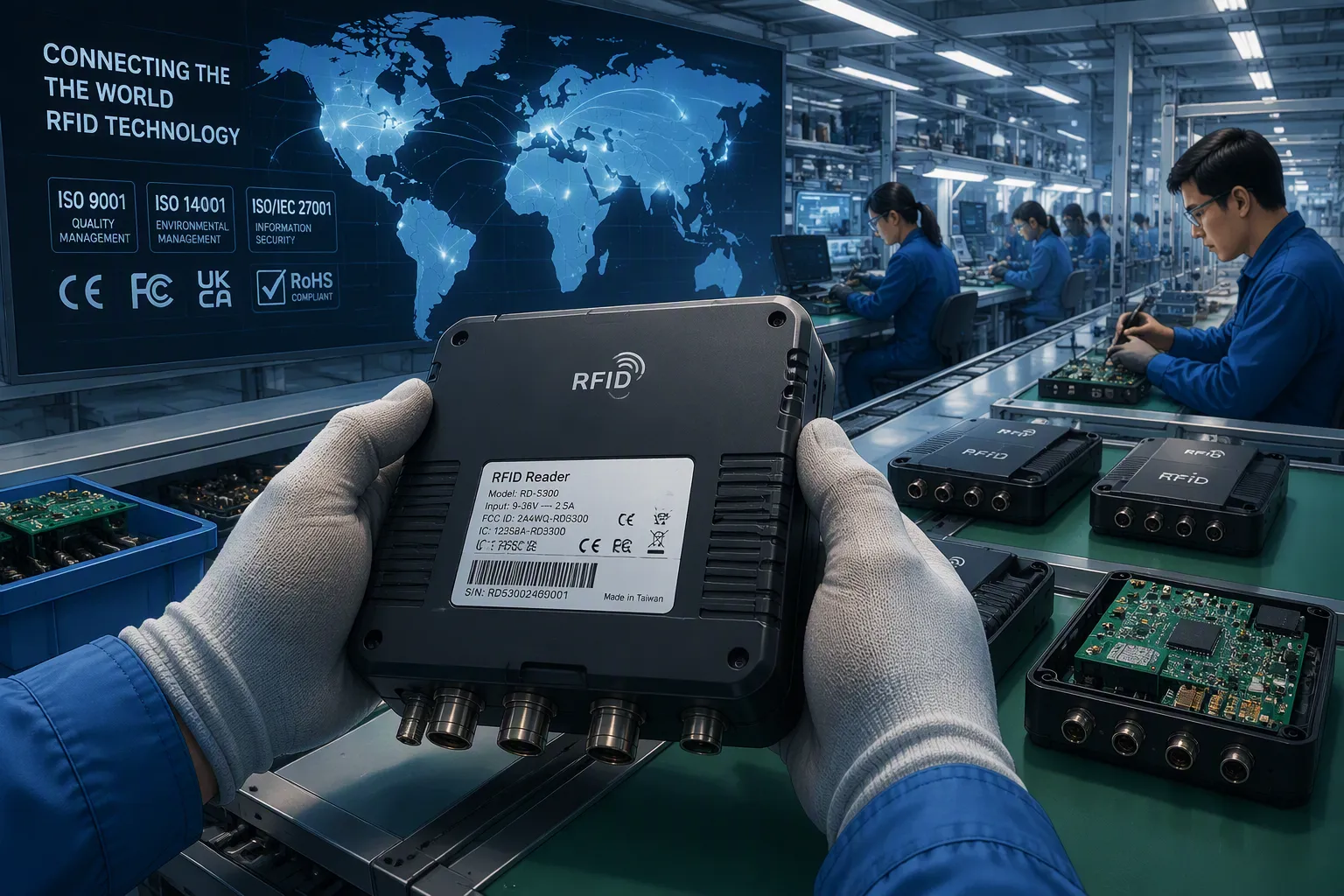
Choosing a supplier for certified RFID readers for a global project is a big decision. One wrong choice can delay your work for months. What matters most? Picking a manufacturer that provides truly certified RFID readers backed by real international certifications. These credentials show that the company meets standards, delivers quality, and can sell in many markets.
You need a simple plan to handle this process. This guide gives you that plan. You will find out which certifications are required in each region, how to find reliable partners that offer certified RFID readers, and how to verify their claims on your own.
Think about the risks: gear without certification can be stopped at borders, lead to fines, or fail to work with other systems. A partner that supplies certified RFID readers removes these problems. You should feel confident about your supply chain. This guide helps you get that confidence.
Key Takeaways
Certified RFID readers help prevent customs delays, fines, and the seizure of products.
FCC approval is required for the US; CE marking is needed for the EU.
Check certifications through official databases and test reports.
Third-party audits show how good and dependable a factory really is.
Look at customer references and case studies to see how well they have performed.
A worldwide RMA policy and available spare parts make sure support runs smoothly.
Well-known makers such as HID Global and Impinj set the standard for quality.
Cheaper options like MarktraceRFID give you certified readers that rarely need repairs.
Why certified RFID readers ensure global compliance
Certifications are not just fancy stickers. They are legal rules that decide if your RFID readers can cross borders, work legally, and perform reliably. Without them, your project could face delays, fines, or even have goods taken away. Knowing why these certifications matter helps you make smarter buying choices from the start.
Meeting regional legal requirements
Every major market has its own rules for radio-frequency devices. The United States requires FCC approval before any RFID reader can be sold, imported, or used. The European Union requires CE marking under the Radio Equipment Directive (RED). Ignoring these rules puts your entire shipment at risk.
Avoiding customs delays with proper documentation
Customs officers actively check for compliance paperwork. In 2024, U.S. Customs and Border Protection flagged over 3,000 RFID-related shipments at American ports for missing proper FCC certification. When an RFID reader arrives without an FCC ID, customs can issue a Notice of Detention. You then must prove compliance by providing the FCC ID grant. If you cannot, the goods may be excluded, destroyed, or sent back, along with fines and increased scrutiny on future shipments.
The table below summarizes what customs expects:
Requirement | Details |
|---|---|
Physical label | FCC-certified devices must display the FCC ID on the product label |
Commercial invoice | Must list the FCC ID for each product line |
Verification process | Customs officers cross-check IDs against the FCC database |
Missing or invalid ID | Results in detention or seizure |
Guaranteeing product quality and reliability
Certifications also show manufacturing quality. A factory that keeps ISO 9001 certification follows documented processes for quality control, testing, and continuous improvement. This standard ensures consistent production, so each unit you receive performs like the last one.
The role of ISO 9001 in consistent manufacturing
ISO 9001 requires manufacturers to document every step of production, from component sourcing to final testing. Auditors verify these processes regularly. When a factory holds this certification, you gain confidence that quality checks happen at every stage. This reduces the chance of receiving defective readers that fail in the field. For international projects spanning multiple countries, this consistency protects your reputation and your timeline.
Simplifying customs clearance worldwide
Proper certification documents reduce friction at every border. When your paperwork matches the product, customs officers can verify compliance quickly. This speeds up clearance and prevents costly delays.
How certification documents reduce border friction
European authorities frequently request specific documents when checking CE compliance. These include test reports, the Declaration of Conformity, label files, and instructions. Having these ready means your shipment moves through customs without unnecessary holds.
The consequences of missing CE marking extend beyond customs. Online marketplaces enforce these rules too. Amazon may delete product listings for RFID readers lacking CE marking. If the violation appears severe or repeated, the platform can suspend the seller's entire account. This risk affects your distribution channels, not just your shipping timeline.
Most RFID readers must comply with the Radio Equipment Directive. This includes low frequency, high frequency, ultra-high frequency, and battery-assisted passive devices. Passive RFID products that operate without a battery fall outside RED coverage. Understanding these distinctions helps you verify that your chosen certified RFID readers meet the correct standards for each market.
Working with a manufacturer that maintains current certifications across multiple regions simplifies your entire project. You avoid the headache of chasing paperwork, the cost of returned shipments, and the damage to your brand from non-compliant products. The right certified RFID readers arrive on time, work as promised, and keep your project moving forward.
Key certifications to verify by target region
Each region has its own rules for RFID readers. You need to know these rules before you buy equipment. The wrong certification can stop your project at the border. When you get certified RFID readers for international projects, you must check that the certifications match your target region. Let's look at the main needs for North America, Europe, and Asia-Pacific.
North America: FCC, UL, and CSA
The United States and Canada need strict certification for RFID readers. The FCC handles all radio frequency devices in the US. Canada uses ISED Canada. UL and CSA are safety certifications that some buyers also ask for.
Understanding the scope of FCC Part 15 rules
FCC Part 15 covers all unlicensed radio frequency devices. For UHF RFID readers, the main rule is Part 15.247. This rule applies to frequency hopping spread spectrum devices. Your RFID reader must pass several tests before it can get an FCC ID.
The FCC needs these specs for UHF RFID readers in the 902–928 MHz band:
Regulatory Aspect | Specification |
|---|---|
Governing Rule | FCC Part 15.247 |
Frequency Band | 902–928 MHz (26 MHz-wide ISM band) |
Modulation Requirement | FHSS or digital modulation |
Conducted Power Limit | Up to 1 Watt |
EIRP Limit | Up to 4 Watts (with 6 dBi antenna) |
Channel Configuration | ~50 channels, each 500 kHz wide |
Dwell Time | Maximum 0.4 seconds per channel |
Licensing | Unlicensed operation; FCC certification required |
The testing covers many measurements. You need to check conducted output power, radiated field strength, EIRP, peak and average power, power spectral density, occupied bandwidth, spurious emissions, band edge emissions, and frequency accuracy. Testing must follow ANSI C63.10 (2013) procedures. For FHSS devices, the test checks minimum channel count, hopping sequence, and the dwell time limit.
Canada closely follows FCC rules. Both use the 902–928 MHz band with a 4 Watt EIRP limit. But Canada needs a separate IC ID certification. You need both certifications for a North American product launch.
European Union: CE Marking, RED, and RoHS
The European Union takes a different path. CE marking shows that a product meets all EU requirements. For RFID readers, the main rule is the Radio Equipment Directive (RED).
The Radio Equipment Directive (RED) approval process
RED covers radio performance, electromagnetic compatibility, and safety. The EU uses the 865–868 MHz band for UHF RFID. The highest EIRP is 2 Watts (33 dBm), which is lower than the US limit.
RED needs two extra features. The first is Transmit Power Control (TPC). This feature adjusts the reader's power based on the environment. The second is Dynamic Frequency Selection (DFS). This feature detects other signals and moves to a different channel. The EU also requires a 10% duty cycle per channel.
The certification process uses a test lab that checks your device against RED standards. You then create a Declaration of Conformity. This document says your product meets all requirements. You must also keep technical files with test results and design details. RoHS compliance limits harmful substances in the product.
Asia-Pacific: SRRC, KC, and TELEC
The Asia-Pacific region has many different certification systems. China needs SRRC approval. South Korea needs KC marking. Japan needs MIC/TELEC certification. Each country has its own test labs and paperwork needs.
Navigating unique local standards like Japan's TELEC
Japan's certification process is one of the most detailed in Asia. RFID readers are seen as Specific Radio Equipment (SRE) under the MIC framework. You must go through a local testing process with a set Certification Body.
The process has five steps. First, you sort your device and send samples to a Japanese Certification Body like TELEC. You need a user manual in Japanese, antenna specs, circuit diagrams, and other papers. Second, the lab runs local tests. This includes RF, EMC, and Safety tests. Third, the body checks all documents for completeness. If they find issues, you need fixes before moving forward. Fourth, after passing, the body gives an MIC certificate. The process takes about 3–4 weeks. The certificate does not expire unless you change the RF features. Fifth, you must put a compliance label (Giteki mark) on the product. The label shows the device classification and certification number.
License-exempt does not mean certification-exempt. Covered specified radio equipment must obey Japan's technical standards and carry the right technical-conformity marking before being sold or used.
Working with a manufacturer that already has these certifications saves you time and money. You can focus on deployment instead of paperwork.
How to find certified RFID readers partners
Finding a reliable partner for international RFID projects takes more than a quick search. You need to know where to look and what to check. The right partner has verifiable credentials and a track record of compliance. Let's walk through the practical steps to find and verify these manufacturers.
Using industry directories and trade databases
Industry directories give you a trusted starting point. Organizations like GS1 Global and AIM Global maintain member lists that include manufacturers who meet specific standards.
Leveraging GS1 Global and AIM Global member lists
GS1 Global runs the global barcode and RFID standards. Their directory includes companies that follow GS1 standards. You can search by region, product type, or certification status. You can filter by product category to find only reader manufacturers. This gives you a shortlist of manufacturers who already meet international requirements.
AIM Global is another valuable resource. Their directory includes RFID hardware manufacturers, software developers, and solution providers. Each member agrees to a code of conduct that includes compliance with industry standards. Finding a manufacturer here means they commit to quality and certification. The organization also publishes white papers on compliance that help you understand what to ask for.
Search both directories. Look for companies that list their certifications clearly. Long-standing members often have more experience and a stronger compliance record. Create a list of potential partners from these sources.
Attending international trade shows
Trade shows give you a direct way to see products and meet manufacturers. You can ask about certification, examine product quality, and compare multiple suppliers in one trip. Two key events for RFID buyers are EuroID and RFID Journal LIVE.
The value of events like EuroID and RFID Journal LIVE
EuroID takes place in Germany each year. This event focuses on RFID, IoT, and identification technologies. Exhibitors come from across Europe and around the world. You can see the latest certified RFID readers and talk to engineering teams directly. The show floor lets you test devices yourself. You can verify that the readers work as claimed and ask about certification documents on the spot.
RFID Journal LIVE is the largest RFID event in North America. It happens in the United States each spring. The conference includes sessions on compliance and certification. You can attend workshops on FCC rules and RED requirements. The exhibit hall features dozens of manufacturers showing their certified products. Meeting people in person builds trust that email alone cannot create.
When you attend these events, bring a checklist of your target region requirements. Ask each manufacturer about their certifications. Request copies of their FCC IDs and CE declarations. Seeing the reader in action also lets you check build quality, antenna performance, and software interface. Compare the quality of documentation between different suppliers. Manufacturers who present clear, organized certificates are usually the ones you can trust.
Requesting and verifying certification documents
After you identify potential partners, the next step is to verify their claims. Request their certification documents and check them carefully. This process separates real manufacturers from those who fake their credentials.
How to spot counterfeit certificates from authentic ones
Counterfeit certificates exist in the RFID market. Some suppliers copy valid certificates from other companies or create fake documents. You need to know what to look for.
Start with the FCC database. Every FCC-certified device has a unique FCC ID. Search this ID on the FCC website. The search returns the original grant, test reports, and photos of the device. Compare the product to the photos on file. If the label, antenna, or internal layout differs, the certificate may not apply.
Check the test lab name. Authentic certificates come from accredited test labs. Look for labs that hold ISO 17025 accreditation. The lab name should match what you find on the official accreditation body website. Cross-reference the lab name with the ISO 17025 directory maintained by the accreditation body. Fake certificates often use names of labs that do not exist or list lab names with spelling errors.
Verify the certificate date. Some standards require periodic updates. Check that the certificate is still valid. An expired certificate means the product may not meet current regulations.
Look at the document quality. Authentic certificates have clear logos, correct formatting, and consistent fonts. Counterfeit documents often have blurry logos, misaligned text, or inconsistent margins. They may also lack the official test report.
A certificate without a matching test report is a red flag. Always ask for the full test report, not just the summary page. The test report shows the specific measurements and confirms that the device passed all required tests.
Request the Declaration of Conformity for CE marking. This document must list the manufacturer's name and address, the product model, and the applicable standards. The signature should match a responsible person in the organization. Check that the standards listed are current, not outdated versions.
Finally, contact the test lab directly. Ask them to confirm that they tested the product for that manufacturer. Most labs will confirm this information if you provide the certificate number. This step takes extra time, but it catches almost all fake certificates.
Following these steps helps you find a genuine partner for certified RFID readers. You avoid the risk of working with a supplier who cannot back up their claims. The time you invest in verification protects your project from delays, fines, and compliance failures.
Criteria for vetting global manufacturers
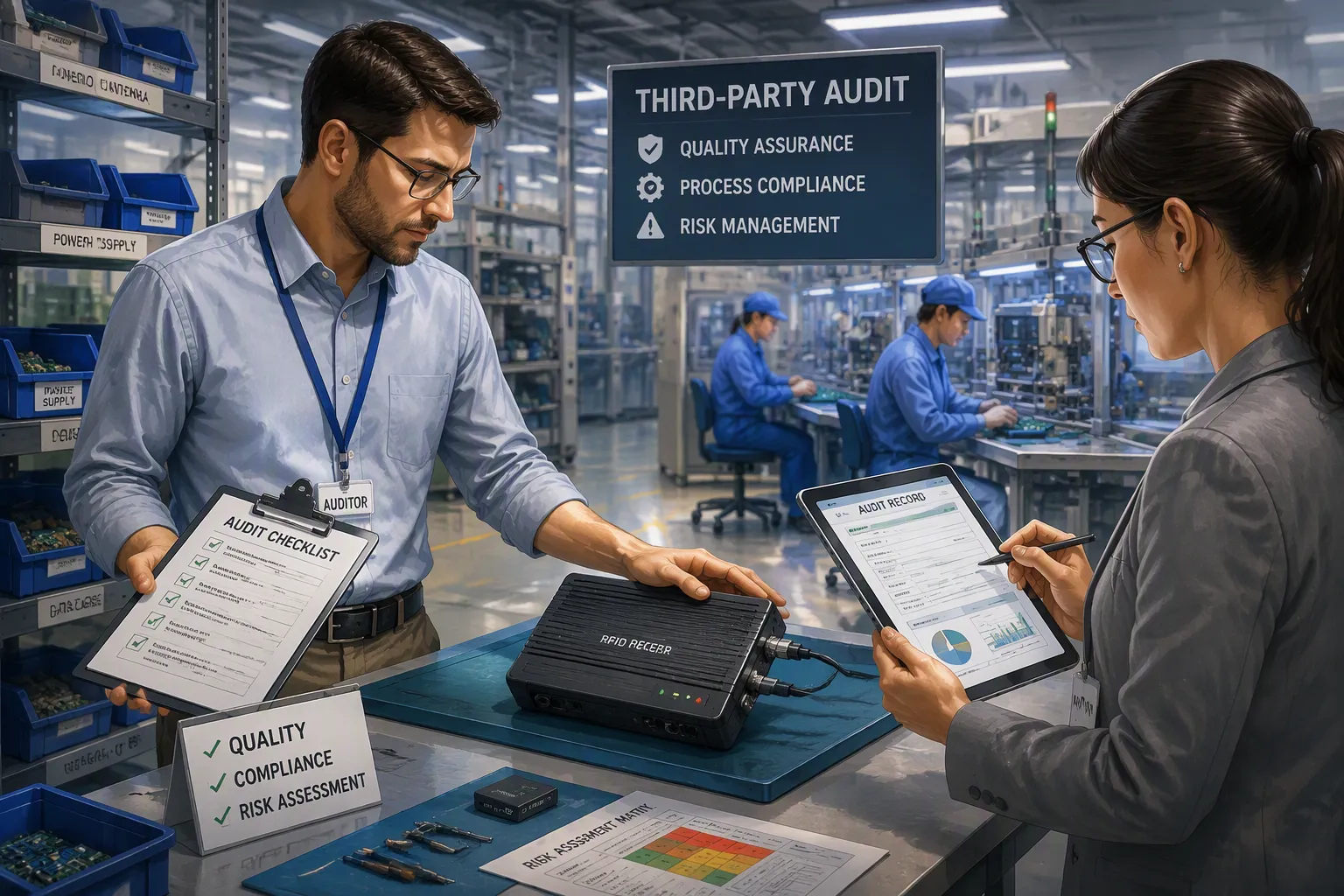
Certificates show a manufacturer passed a test on one day. They do not show the factory builds good products every day. You need to dig deeper. Audits, customer references, and warranty terms show the true ability of a supplier. These checks separate real partners from companies that just gathered paperwork.
Conducting third-party audits
A third-party audit gives you an independent look inside the factory. You hire an outside firm to check production lines, quality controls, and testing procedures. This audit finds problems that documents cannot show. You learn how the factory really works, not how it says it works.
The value of a qualified ISO 9001 audit report
An ISO 9001 certificate tells you the factory follows written processes. A qualified audit report tells you those processes work in real life. The auditor checks if workers follow the steps, if testing tools are calibrated, and if defects get tracked and fixed.
Risk scoring helps you rank suppliers across many areas. You can check cybersecurity, operational strength, and partnership quality to see total risk. This scoring helps you choose wisely before you sign any contract. The audit process has several steps: telling the purpose, finding built-in risks, checking current controls, measuring leftover risk against your company's comfort level, and working with the vendor on a fix plan if risks go too high.
Real-world examples show what happens without proper supplier risk management. Marriott, Whole Foods, and Ocala all had breaches that caused reputation damage, money loss, and work stoppage. A third-party audit would have found these risks earlier. You want to catch problems before they become your problems.
Continuous monitoring adds another layer of safety. Real-time data on supplier security finds new weaknesses and policy changes early. Fix plans give vendors clear steps to close gaps, helping both sides lower risk together. This step-by-step method finds problems early in the supplier selection process, before contracts are signed.
Checking customer references and case studies
References and case studies show how a manufacturer performs in real projects. You want examples from projects close in size and region to yours. A manufacturer that delivered 50 readers to a local warehouse may not handle 5,000 readers across three countries.
Requesting examples from projects similar in scale and region
Ask for case studies that match your project profile. Look for the client type, the size of the rollout, and the region. A manufacturer serving big clients like Huawei or SAIC Motor shows they can handle tough demands. A repair rate of only 0.4% tells you their products rarely break in the field.
When you check references, ask specific questions. The table below shows what to ask and what proof to request:
Evaluation Area | Specific Questions to Ask | Documented Evidence from Manufacturer |
|---|---|---|
Certification | Does the CE certificate cover the exact model I plan to import? | CE RED Certificate clearly lists model numbers covered |
Customization | Can the reader be customized for our housing design and interface setup? | ODM/OEM customization options for antenna gain and interface |
MOQ & Lead Time | What is the minimum order size and lead time for a UHF RFID reader? | MOQ as low as 2 units with 7–15 days lead time |
Samples & SDK | Do you provide samples or a development kit before mass production? | Development kit includes reader bundle, demo software, and sample tags |
Production Capacity & QC | Can you fill a 5,000-unit order, and what are your quality control steps? | Monthly capacity of 1,000 UHF fixed readers with Factory Acceptance Testing |
After-Sales Support | What is your after-sales support model for international rollouts? | Remote support for standard readers, on-site support for ODM projects |
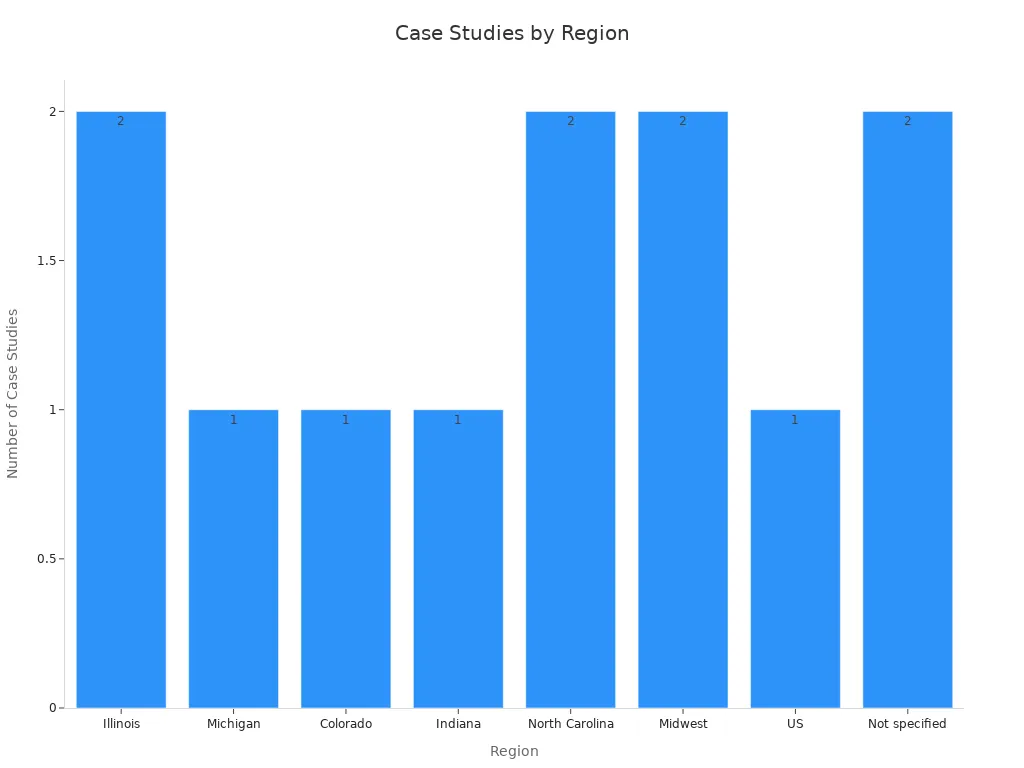
Case studies also show regional experience. The chart below shows how one manufacturer's case studies spread across regions, showing their ability to handle projects in different markets.
Evaluating warranty, support, and logistics
A manufacturer's warranty and support terms tell you how they handle problems after the sale. International projects need support that works across time zones and borders. You need clear answers about what happens when a reader fails in the field.
The importance of a global RMA policy and spare parts availability
A global Return Merchandise Authorization (RMA) policy defines how you return broken units. You need to know the process, the timeline, and who pays for shipping. Some manufacturers require you to send units back to their factory in China. Others have regional service centers that cut shipping time and cost.
Spare parts availability matters just as much. If a reader fails, you need replacement parts fast. Ask about their spare parts stock and whether they keep parts for older models. A manufacturer that supports products for many years shows trust in their hardware.
Look for warranty terms that match your project timeline. A one-year warranty may not cover a three-year rollout. Ask about extended warranty options and what they cost. Also check whether the warranty covers labor, shipping, or only the hardware itself.
Delivery terms affect your logistics planning. Common terms include EXW, FOB, and CIF. Each shifts responsibility for shipping and insurance to a different party. Understand these terms before you negotiate. A manufacturer that offers flexible delivery options makes your logistics easier.
The best manufacturers back their products with clear, written policies. They share their repair rates and stand behind their numbers. When you find a supplier with a 0.4% repair rate, you know their products work. When they offer remote and on-site support for international rollouts, you know they will help when problems arise.
Vetting takes time, but it protects your project. You avoid the cost of failed rollouts, the delay of non-compliant equipment, and the damage to your reputation. The effort you put into checking audits, references, and warranty terms pays off in a steady supply of certified RFID readers that work as promised.
A short list of established certified manufacturers
You can begin your search with well-known companies like HID Global, Impinj, and Zebra Technologies. These firms set the standard for certified RFID readers. They hold all key certifications for North America, Europe, and Asia-Pacific. Their products act as a guide for quality and compliance. If you want a trusted partner with a strong history, these manufacturers are a safe pick.
Global leaders with verifiable compliance
HID Global, Impinj, and Zebra Technologies as benchmarks
HID Global, Impinj, and Zebra Technologies work in every major region. Their readers have FCC approval for the US market and CE marking for the European Union. They also meet RoHS rules for environmental safety. These companies spend a lot on testing and certification. You can find their certifications on public databases. Their products work well across borders. However, their solutions often cost more. For projects with tight budgets, you may need a cheaper option.
A high-performance alternative for cost-sensitive markets
MarktraceRFID’s full-stack IoT solutions and 20-year track record
MarktraceRFID offers a strong choice for buyers watching costs. The company has over 20 years of experience in RFID technology. Its readers carry FCC, CE, and RoHS certifications. They support multiple frequency bands for the US, China, and the EU. The table below shows the key performance numbers.
Metric | Value |
|---|---|
Certifications | FCC, CE |
Frequency | US (902–928MHz), China (920–925MHz), EU (865–868MHz) |
Read Speed | Multi tag: 200 pcs/second, single tag: 2000 times/minute |
Reading Range | 6 m |
Sensitivity | -80 dBm |
MarktraceRFID also keeps a repair rate of only 0.4%. This means very few units fail in the field. The company serves Fortune 500 clients like Huawei and SAIC Motor. Its factory in Shenzhen handles the whole production process. You get full customization options and quick delivery. For projects in Southeast Asia, the Middle East, and Latin America, this manufacturer gives high value at a low price.
Specialized manufacturers for niche applications
ELATEC’s multi-country certification and broad credential support
ELATEC focuses on specialized RFID readers for unique uses. Its readers are certified for sale in up to 110 countries. This multi-country certification makes global market entry easier. You can use one product across many regions without extra approvals. ELATEC also supports a wide range of credential formats. This makes it a great pick for projects that need broad compatibility. If your project targets multiple countries with different rules, ELATEC offers a ready solution.
You now have a clear path forward. Follow these three steps to secure a reliable partner.
Request and verify certification documents. Ask for FCC IDs, CE declarations, and test reports. Check them against official databases. This step prevents customs delays and legal issues.
Conduct a site visit or virtual audit. Walk through the production floor. Watch how workers test each unit. Ask about quality control procedures. A factory tour reveals more than any brochure.
Negotiate a pilot order. Start with a small batch of readers. Test them in your real environment. Confirm they meet performance and compliance standards before scaling up.
This diligence protects your timeline, your budget, and your reputation. It transforms a risky procurement into a confident partnership.
FAQ
How do I verify a manufacturer's FCC certification?
Look up the FCC ID on the official FCC website. The database shows the original grant, test reports, and product photos. Compare the photos to the actual product. Make sure the test lab has ISO 17025 accreditation. Call the lab directly to confirm they tested the product.
What certifications do I need for the European market?
You need CE marking under the Radio Equipment Directive (RED). This covers radio performance, electromagnetic compatibility, and safety. RoHS compliance limits harmful substances. The EU uses the 865–868 MHz band with a 2 Watt EIRP limit. Transmit Power Control and Dynamic Frequency Selection are required.
Can I customize RFID readers for my specific project?
Yes. Many manufacturers offer ODM and OEM customization options. You can adjust antenna gain, interface setup, and housing design. MarktraceRFID provides in-house hardware design and full customization. Their factory manages the entire production process from PCB assembly to aging tests.
What is the typical lead time for RFID reader orders?
MarktraceRFID offers lead times of 7–15 days for standard orders. Their minimum order quantity starts at just 2 units. This flexibility helps you test products before committing to large volumes. Their Shenzhen factory manages the whole production process for faster delivery.
How do I handle warranty claims for international projects?
Look for a manufacturer with a global RMA policy. Ask about the return process, timeline, and shipping costs. Check if they offer remote support for standard readers and on-site support for ODM projects. MarktraceRFID provides both options for international rollouts.
What is the minimum order quantity for RFID readers?
MarktraceRFID offers a minimum order quantity as low as 2 units. This low threshold lets you test samples before mass production. You can request a development kit that includes a reader bundle, demo software, and sample tags. This approach reduces your initial investment risk.
How do I test RFID readers before a full-scale rollout?
Request samples or a development kit first. Test the readers in your real environment. Check read speed, range, and sensitivity against your requirements. MarktraceRFID's readers achieve 200 tags per second and a 6-meter reading range. Confirm performance matches your needs before scaling up.
What makes MarktraceRFID different from global leaders like HID Global?
MarktraceRFID offers similar certifications at a lower cost. Their repair rate stands at only 0.4%. They serve Fortune 500 clients like Huawei and SAIC Motor. Their products work well in cost-sensitive markets like Southeast Asia, the Middle East, and Latin America.
- Next>:Recommend a professional RFID system provider for enterprise asset management

 2026-08-31
 Blogs
Blogs