
Help me find a car parking RFID reader manufacturer

Finding a reliable car parking RFID reader manufacturer comes down to six steps. You set your needs, look into possible choices, check how well the tech works, confirm it meets the rules, weigh cost and value, and make a short list with sample testing. The goal is a process you can repeat, not one "best" brand. This way, you can compare every RFID reader manufacturer fairly.
The risks are real. A parking reader works outside in tough lanes for years. A bad choice shows up later as failed reads, gate downtime, and support problems.
Each step below is something you can act on. You can start using it today.
Key Takeaways
Start by defining what you need. Make a clear list of what the reader has to do. This helps you compare suppliers in a fair way.
Look for manufacturers by going to trade shows, checking online directories, and asking for referrals. Each source gives you different helpful information.
Check how well it works in real life. Ask for actual numbers on read accuracy and speed. Test how long it lasts and how well it works with other systems.
Check that it meets the rules. Make sure the reader has the right certifications for your area. Confirm the frequency rules and quality standards.
Look at the total cost, not just the price. Include installation, maintenance, and downtime. Compare warranties and support terms.
Pick your top choices and test samples in your own lanes. Use your tags and software. Run a pilot before you commit.
Ask for proof, not just promises. Certificates, test reports, and references show that a company is reliable. A fancy brochure does not.
Begin today. Write down what you need and start looking. Taking time to choose carefully saves time and money later.
Define Your Requirements
A clear spec sheet turns a vague search into a fair comparison. You write down what the reader must do before you contact any supplier. Then every candidate gets measured against the same list. Without this step, you end up comparing brochures instead of real abilities.
Map Application and Environment
Lane types and traffic volume
Start with the lanes the reader will serve. An entry lane at a busy commercial garage acts very differently from an internal access point at an office park. Count the vehicles per hour at peak. Note whether the lane handles mixed traffic, such as monthly pass holders and visitors. High-volume lanes put more stress on read speed and anti-collision performance.
Weather and vandalism exposure
Outdoor lanes expose hardware to rain, dust, heat, and cold. Write down the local climate extremes and the expected operating temperature range. Check whether the reader sits under a canopy or in open air. Think about vandalism risk at unattended lots. A sturdy housing and a high IP rating matter more in exposed positions.
Set Read Range and Tag Targets
Windshield-tag read distances
Define how far the reader must detect a tag before the vehicle reaches the gate. A comfortable margin gives the controller time to verify the tag and raise the barrier. State the distance from the reader to the typical tag position on the windshield. Test this figure later with your own tags, not the supplier's demo tags.
Frequency band and tag standard
Pick the frequency band and tag standard your system will use. UHF parking systems commonly operate in the 860–960 MHz range with ISO18000-6C (EPC Gen2) tags. Confirm that the reader, the tags, and any existing infrastructure share the same standard. A mismatch here forces a full system replacement later.
List Integration Needs
Interface and protocol requirements
List every connection the reader must support. Common options include Wiegand, RS-485, Ethernet, and an API for software-level control. Match the interface to your controller and network layout. Note whether you need a direct cloud connection or a local controller link.
Parking software compatibility
Check that the reader works with your parking management software before you shortlist anyone. Ask the manufacturer for the integration documentation and a list of software partners. Confirm the data format the reader outputs. A reader with strong specs still fails if it cannot talk to your software.
Research RFID Reader Manufacturers
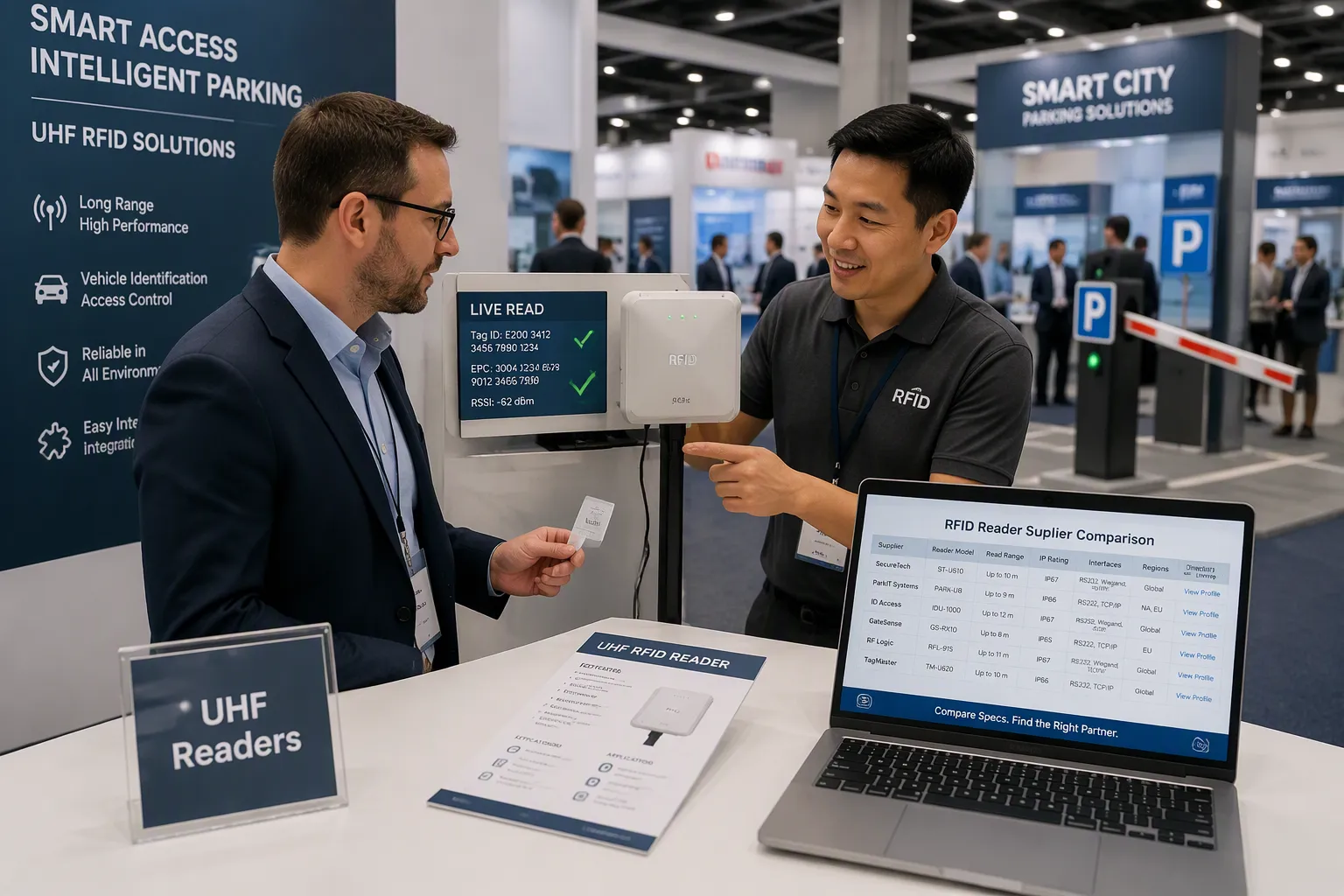
You now have a requirements sheet. The next job is to build a list of candidates worth evaluating. Three channels work well together: trade shows, online directories, and industry referrals. Each one gives you something the others cannot. Use all three and you get hands-on experience, market breadth, and proof from real installations.
Use Trade Shows and Expos
Parking and access-control events
Industry events let you touch the hardware yourself. Look for expos about parking management, access control, and smart city infrastructure. These shows bring in the companies that build lane equipment. That means you can meet several RFID reader manufacturer teams in one day. Check the exhibitor list before you travel. Mark the booths that match your requirements sheet, and plan your time around them.
Checking exhibitors on-site
A booth visit tells you more than a spec sheet. Ask the rep to show a live read with a windshield tag. Watch how the reader handles several tags at once. Ask for the datasheet right there and compare the stated read range to your target distance. Ask who handles technical support in your region. A confident, specific answer shows a mature operation. A vague answer tells you something too.
Search Directories and B2B Platforms
Filtering by category and certifications
Online directories give you a wide view. You can scan dozens of suppliers across many regions without leaving your desk. Filter by product category first, such as UHF readers or vehicle access systems. Then filter by certifications. If your project needs FCC or CE marks, use those as search filters. Save every candidate that passes both filters into one comparison file.
Spotting listing red flags
A polished listing does not prove a supplier is capable. Watch for these warning signs:
Product photos that look like stock images with no model number
Specs that list a frequency range but no tag standard
No physical address or factory information
Certificates shown as images with no issuing body named
Prices far below the market range for similar hardware
Treat each red flag as a question to ask, not an automatic rejection. A short email to the supplier will confirm whether the listing reflects a real product line.
Ask for Industry Referrals
Operators, integrators, and installers
Referrals give you the strongest signal of all: a proven track record. Talk to parking operators who run lanes like yours. Ask system integrators which RFID reader manufacturer they trust for outdoor installations. Talk with installers, because they see which units fail and which ones last for years. One honest talk with an installer can save you months of evaluation.
Reference questions to ask
Prepare a short set of questions before you call any reference. Ask these questions:
How long has the reader run in your lanes, and how well has read reliability held up over that time?
How fast did the supplier respond when you reported a problem?
Did the unit meet its stated read distance in real traffic?
How often do you replace hardware, and why?
Would you buy from this supplier again?
Write down the answers the same way for every reference. Patterns will show up fast. Two or three references that describe steady performance and fast support mean more than any brochure.
Combine the three channels before you move on. Trade shows give you direct product experience. Directories widen the pool and bring up regional options. Referrals confirm how candidates perform after installation. Together they turn a long list of names into a focused set of serious contenders. You can then judge each RFID reader manufacturer on technical evidence rather than sales claims.
Evaluate Technical Performance
Check Read Accuracy and Speed
Read rate in real lanes
Read accuracy means the reader picks the right tag on the first try, almost every time. Ask for real-world data from lanes with traffic like yours. A demo room hides problems that real lanes show, like tag angle, vehicle speed, and interference from nearby metal.
Multi-tag handling
Busy lanes sometimes have several tags at once, especially when a vehicle pulls a trailer or carries a second transponder. Anti-collision performance decides whether the reader sorts these tags cleanly. Ask for a live demo with multiple tags in the field.
Strong specifications give you a fair benchmark for comparison. The MARKTRACE RFID UHF Vehicle Management Solution shows the kind of numbers to look for:
Component | Key specifications |
|---|---|
MR6211E long-range reader | Adjustable RF power 0–30 dBm, −80 dBm sensitivity, 12 dBi linear polarization antenna |
MR6261E desktop reader/writer | Up to 200 tags/sec read speed, 3 m range |
MR6700A card | ISO18000-6C (EPC Gen2), 860–960 MHz, fixed-frequency or FHSS modes |
Treat these figures as reference points, not the only option on the market.
Review Durability and Build
IP rating and temperature range
Check the IP rating and operating temperature range against your climate data from Step 1. Ask for the datasheet value and a test report that backs it up. A rating printed on a flyer means little without evidence.
Housing and surge protection
Check the housing material and the surge or lightning protection design. Outdoor lanes attract electrical surges through cables and mounting structures. Ask how the reader protects its ports and whether the supplier documents that protection.
Assess Integration and Support
SDKs, protocols, firmware policy
Ask which SDKs and protocols the manufacturer provides. Confirm the firmware update policy in writing. A clear policy on updates and backward compatibility protects your investment over a multi-year deployment.
Documentation and responsiveness
Request the integration documentation before you commit. Send a technical question and time the reply. Fast, specific engineering answers show a supplier who will support you after the sale.
Check Regulatory Compliance
Confirm Regional Certifications
FCC and CE marks
The FCC mark shows a device meets United States electromagnetic and radio rules. The CE mark means it follows European Union directives. Your target market decides which marks you need. A reader sold in both regions should carry both.
Other markets have their own rules. Ask the manufacturer which marks the exact model carries, not just the brand. Request the certificate for the model number you plan to buy. A certificate for a similar product does not cover your unit.
Other regional requirements
Some countries require local type approval before a radio device can be sold or installed. Ask the supplier if they hold approval for your country. Confirm the approval covers the frequency band you plan to use. Add this question to your requirements sheet from Step 1.
Verify Frequency Regulations
Allowed bands and power limits
The 860–960 MHz UHF range is regulated differently across countries. Each country sets its own allowed bands and transmit power limits. A reader tuned for one market may exceed local limits in another. Confirm the reader's power settings can match your local rules.
Ask the manufacturer to state the approved bands and power limits for your region in writing. Check that the reader's adjustable RF power range covers the local ceiling. A unit with fixed power settings may not fit your market at all.
Compliance testing evidence
Request the test reports behind each certificate. The report should name the model, the standard tested, and the testing laboratory. Compare the model number on the report to the unit you will order. This step catches mismatches early.
A certificate without a matching test report is a claim, not evidence.
Review Quality Standards
ISO and quality management
Quality management certifications, like ISO 9001, show a documented production process. Ask which certification body issued the certificate and when it expires. A current certificate from a recognized body means more than a logo on a website.
Safety and EMC documentation
Ask for the safety and electromagnetic compatibility (EMC) documents for the model. EMC matters in parking lanes, where readers sit near motors, barriers, and power cables. The documents should show the unit passed emissions and immunity testing. File these documents with your requirements sheet. They support warranty claims and site inspections later.
Assess Cost and Value
Calculate Total Cost of Ownership
Unit price vs. lifecycle costs
The sticker price is just the first number to think about. Total cost of ownership adds installation labor, mounting hardware, cabling, spares, maintenance visits, and downtime over the reader's service life. A cheaper unit that needs frequent service can cost more than a premium unit that runs untouched for years. Build a simple spreadsheet for each finalist. List the unit price, then add every cost you expect over the deployment period.
Downtime and replacement costs
Downtime hurts more than any invoice line. A failed reader at a busy exit lane backs up traffic, upsets drivers, and may force staff to open the gate by hand. Estimate the cost of one hour of lane downtime at your site. Multiply that figure by the failure rate you expect from each candidate. Replacement cost also includes the labor to swap the unit and the time to set it up again. Ask each supplier for their expected service life and mean time between failures.
Compare Warranty and Support
Warranty scope and length
Warranty length varies a lot across the market. Read the scope as carefully as the duration. Does the warranty cover parts only, or parts and labor? Does it cover surge damage, water ingress, and normal wear? Ask how the supplier handles a claim in your region. A long warranty with a slow claims process offers little real protection.
Spare parts and response times
Ask how quickly the manufacturer can ship a replacement reader or antenna to your site. Confirm whether they hold spare stock in your region or ship from overseas. Request their stated response time for technical support tickets. Compare these commitments across finalists and write them into your comparison file. Fast spares and clear response targets lower the risk of long lane closures.
Weigh Customization and Order Terms
OEM/ODM and customization limits
Some buyers need branded housings, custom firmware, or a specific connector layout. Others need a standard unit at the best price. OEM and ODM programs fit the first group, while branded supply fits the second. Ask each supplier which options they offer and where the limits sit. Confirm whether customization affects certification, warranty, or lead time.
MOQ, lead times, and payment terms
Minimum order quantity, lead time, and payment terms are talking points, not fixed walls. Ask for the MOQ for your exact configuration. Request a written lead time and compare it to your installation schedule. Discuss payment terms that match your cash flow. Record every term in writing before you compare finalists side by side.
Shortlist RFID Reader Manufacturers
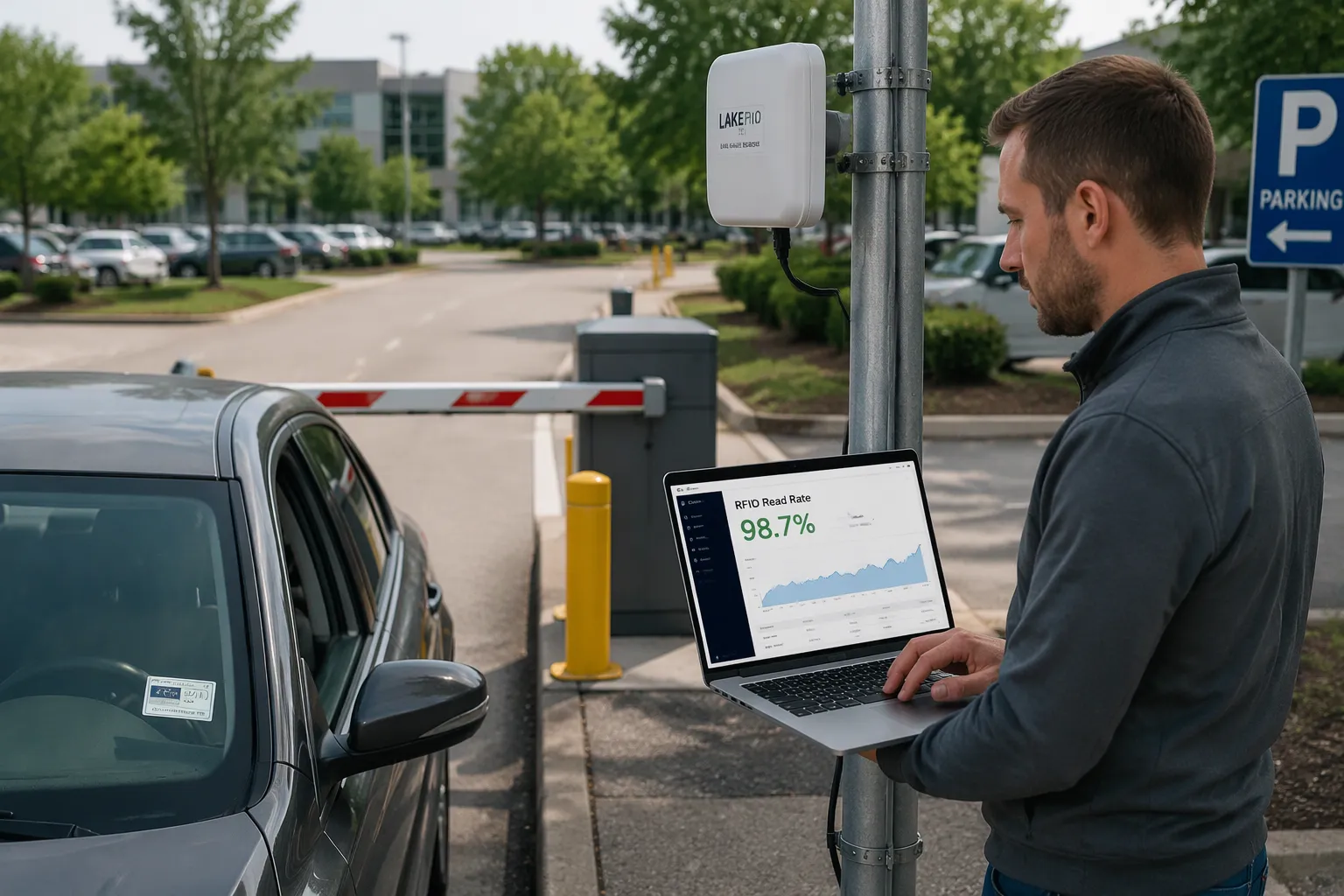
You now have a requirements sheet, a research list, technical data, compliance evidence, and cost figures. Now you use that material to make a decision. This stage separates serious contenders from the rest. It also keeps you from signing with a supplier whose demo performance never shows up in your lanes.
Build a Scored Shortlist
Criteria weighting
Give a weight to each criterion on your requirements sheet. Read reliability usually gets the highest weight, because a reader that misses tags causes every other problem. Compliance comes next for any regulated market. Support responsiveness, durability, integration fit, and price follow in an order that matches your site. Use a simple scale, such as 1 to 5, and keep the total fixed so every candidate faces the same math. A weighted score turns opinion into a number you can defend to colleagues and managers.
Narrowing to finalists
Score every candidate against the weighted criteria. Sort the results and keep the top three to five. Drop any supplier with missing compliance evidence or no regional support, no matter the score. A shortlist of three to five gives you enough choice without spreading your testing effort too thin. Tell each finalist they made the shortlist. This often improves their pricing and their attention to your questions.
Run a Real-World Sample Test
Lane testing with your tags
Ask each finalist for a sample unit and test it in your actual lanes. Use your own windshield tags, not the supplier's demo tags. Mount the reader at the planned height and angle. Drive vehicles through at normal speed and at peak-hour speed. Record the read rate, the read distance, and any missed reads over a few hundred passes. Test in rain or heat if your climate allows. A reader that performs in your lane with your tags has proven something a datasheet cannot.
Integration trial with your software
Connect the sample reader to your parking management software. Confirm the data format, the interface, and the gate trigger all work as expected. Run a full entry and exit cycle with a test vehicle. An end-to-end system makes this trial easier to judge. The MARKTRACE RFID UHF Vehicle Management Solution, for example, pairs a long-range reader with a desktop reader/writer for tag programming and ISO18000-6C cards, so you can test the whole chain from tag issue to gate open. Treat that setup as one example of what a complete trial might cover, not the only path.
A sample that passes your lane test with your tags and your software has earned its place on the shortlist. A sample that only passes a demo room has not.
Confirm Terms Before Committing
Pilot orders and trial periods
Ask for a pilot order before a full rollout. A pilot covers one or two lanes for a set period. Write the trial terms into an agreement. State the performance targets, the support commitments, and the return conditions if the unit misses those targets. A supplier who welcomes a written pilot shows confidence in the product. A supplier who resists one gives you useful information too.
Final pre-signing checklist
Run this checklist against your chosen RFID reader manufacturer before you sign:
Certificates and test reports match the exact model number you will order.
Warranty scope, length, and regional claims process are in writing.
Lead time and delivery schedule match your installation plan.
Spare parts stock and support response times are confirmed.
Pilot performance met the targets in your trial agreement.
Payment terms and MOQ are recorded in the contract.
Walk away from any gap you cannot close in writing. A short delay now costs far less than a failed lane later. The right RFID reader manufacturer will meet this checklist without friction, and that ease is itself a sign of a mature supplier.
You now have a clear plan: define your needs, research candidates, evaluate performance, check compliance, assess cost, and shortlist with sample testing. Run these six steps in order, and every supplier gets the same fair comparison.
Reliability comes from evidence. Test data, certifications, references, and sample performance in your own lanes tell you far more than a polished brochure ever will.
Start Step 1 today. Write down your requirements, then begin researching and shortlisting each RFID reader manufacturer against that list. A well-run selection process pays off for years. Stable lanes, fewer failures, and steady support all trace back to the homework you do now.
FAQ
How long does it take to choose a parking RFID reader supplier?
The timeline depends on your project size and how fast you gather evidence. The six steps give you a path you can repeat. Most of the time goes into lane testing and compliance checks. Start with your requirements sheet, then move through research and evaluation in order.
Can one reader model cover every lane on my site?
Not always. Entry lanes, exit lanes, and internal access points differ in traffic volume and read distance needs. Match each lane type to the right reader and antenna. A long-range unit suits a main gate; a shorter-range unit may fit an internal door.
What should I ask a supplier on the first call?
Ask for the datasheet, the tag standard, and the interface options. Confirm the model's FCC or CE status for your market. Request a reference from a site like yours. A supplier who answers these questions quickly and specifically is worth a second call.
What does a good sample test look like?
Test in your own lanes with your own tags. Record read rate and read distance over several hundred vehicle passes. Connect the reader to your parking software and run a full entry and exit cycle. Demand evidence, not a demo room.
Which specifications matter most for outdoor lanes?
Prioritize read reliability, IP rating, and operating temperature range. Confirm surge protection for ports and cabling. Check that adjustable RF power covers your local limits. The 860–960 MHz band and ISO18000-6C tags are common reference points for UHF parking systems.
How do I judge technical support before I buy?
Send a technical question and time the reply. Ask for integration documentation up front. Confirm the firmware update policy in writing. Request stated response times for support tickets. Fast, specific engineering answers signal a supplier who will stay engaged after the sale.
What mistakes should I avoid during selection?
Three common ones stand out:
Choosing on unit price alone, without lifecycle costs
Skipping the lane test and trusting a demo room
Accepting a certificate that does not name your exact model
Each mistake shows up later as downtime, failed reads, or compliance trouble.
Do I need a pilot order before a full rollout?
Yes, when you can get one. A pilot covers one or two lanes for a set period. Write the performance targets, support commitments, and return conditions into the agreement. A supplier who welcomes a written pilot shows confidence in the product.
- Next>:Recommend a professional RFID parking solution provider

 2026-07-13
 Blogs