
Looking for a company that manufactures active RFID personnel tags for factories
A factory buyer needs a dependable maker of active RFID personnel tags. The fastest way to make that choice is to judge companies by clear standards, not by a pile of brochures. This post gives readers a practical framework for that evaluation. It focuses on needs, tag performance, how well the tag fits the job, rules, cost, and vendor support. Readers will learn how to build a shortlist of qualified manufacturers. They will also gain the right questions to ask each supplier before any commitment. Finally, the framework shows how to run a useful pilot and measure real results. Each step builds on the one before it, so the final choice rests on evidence rather than sales claims.
Key Takeaways
Figure out what your factory needs to track first: the areas, the setting, and the kind of tag.
Compare active RFID tags by looking at proven specs, durability ratings, and real test data.
See how well the tags work with your needs, your current systems, and your plans to grow.
Check the RF and safety certifications for each site and each way the tag is worn.
Figure out the full cost of owning the tags, not just the price of one tag.
Check what the vendor supports, like site surveys, SLAs, and help with integration.
Make a ranked shortlist and run a small test with clear passing scores before you commit.
Define Factory Tag Requirements
A factory buyer should begin with the job the system must do, not with the product itself. Decide what the system tracks, where the tags will work, and which operating rules apply. This order stops a common mistake: picking a tag first and then finding out it cannot handle the site.
A short comparison of RFID types helps here. Passive tags have no battery and depend on the reader's field. Active tags have their own power source, so they give a longer read range and more frequent updates. Hybrid setups are common in factories. Teams often use passive tags for general inventory and active tags for critical personnel and assets.
Map Read Range Needs
Zone-level vs. real-time accuracy
Zone-level tracking reports which area a worker is in, such as a bay or a floor. Real-time location goes further and follows movement without stopping. Zone-level systems need fewer readers and simpler infrastructure. Real-time systems need denser reader coverage and higher tag transmission rates. The buyer should decide which level the operation truly needs before comparing hardware.
Distances for mustering and doorway detection
Mustering and doorway detection need different ranges. Identium One reports a muster detection range of up to 100 m typical and 400 m line-of-sight, confirmed by site survey. RFID Softwares describes long-range passive UHF systems that detect cards automatically from 6 to 10 meters as people walk through a muster area, with no tapping required. TrackerIoT lists shorter figures for tighter use cases:
Use case | Read range |
|---|---|
Smart turnstiles (doorway detection) | UHF RFID badges from 3–6 feet away |
High-risk area sensors (localized pinpointing) | tuned radius of up to 40 feet |
Survey Environmental Conditions
Metal, concrete, and machinery effects
Factory structures change how RF behaves. Free-barcode.com notes that metal surfaces reflect or absorb radio waves and can weaken or block the signal. Dense materials such as concrete resist penetration, which shortens range or causes missed reads. Motors, generators, and power lines give off electromagnetic fields that disrupt signals and cause misreads or no reads at all.
Factor | Effect on RFID signal and read range |
|---|---|
Metal surfaces | Reflect or absorb radio waves; signal weakened or blocked |
Dense materials (concrete) | Poor penetration; reduced range or failed detection |
Machinery and electrical equipment | Electromagnetic interference; misreads or no reads |
Dust, moisture, and temperature exposure
Dust, moisture, and heat shorten tag life and make reads less reliable. The buyer should record the site's actual exposure levels and match them to the tag's sealed enclosure and rated operating range.
Choose the Tag Form Factor
Badge, wristband, and helmet-mount options
Badges suit access control and turnstile lanes. Wristbands fit workers who cannot clip a badge. Helmet mounts serve hands-free environments. On-metal tags fit assets near steel structures, reusable hard tags absorb impact in rough handling areas, and high-temperature tags suit heat-exposed zones.
Wearability and worker acceptance
Workers accept tags they barely notice. Weight, clip security, and comfort across a full shift all affect compliance. A tag that irritates the wearer ends up in a locker, and the tracking data quietly disappears.
Compare Active RFID Personnel Tags
Once the needs are clear, the buyer can compare products on equal terms. This stage separates marketing claims from performance you can measure. Each tag type and each manufacturer fits a different situation. A rugged tag with a long battery life suits a heavy plant. A lighter badge suits an assembly line next to an office. The comparison should show where each option works best.
Check Core Tag Specs
Battery life claims and verification
Battery life is the first spec most buyers read, and it is the easiest one to misread. A datasheet figure usually assumes a low transmission rate, room temperature, and ideal signal conditions. Real factory traffic raises the transmit frequency and shortens the life. Buyers should ask for documented test data behind the claim, not just the datasheet number. A useful request is the test protocol: transmission interval, ambient temperature, and the discharge threshold used. Manufacturers who track field returns can also share real replacement rates. That evidence tells the buyer more than a headline figure.
Transmit power and read reliability
Transmit power drives read range, and read range drives reliability at the edge of a zone. Higher power helps a tag reach a distant reader, but it also drains the battery faster and can cause read collisions in dense areas. The buyer should compare tags at the same power setting and the same reader placement. A tag that reads reliably at a doorway with a short burst may fail in a crowded muster yard. Ask each manufacturer for read-rate data from a site like the target factory. Documented test data beats a laboratory claim every time.
Review Durability Ratings
IP ratings for dust and water
The IP rating states how well the enclosure keeps out solids and liquids. The first digit covers dust and the second covers water. A tag rated for dusty bays and wash-down areas needs a high score on both digits. The table below shows how the common ratings differ in practice.
IP rating | Dust protection | Water protection | Typical factory fit |
|---|---|---|---|
IP54 | Limited dust ingress | Splashes from any direction | Light assembly, covered areas |
IP65 | Dust-tight | Low-pressure jets | General production floors |
IP67 | Dust-tight | Temporary immersion | Wash-down and outdoor yards |
A higher rating usually adds bulk and cost. The buyer should match the rating to the actual exposure, not to the worst case imaginable.
Impact, vibration, and temperature ranges
Factories subject wearable tags to drops, knocks, and constant machine vibration. The buyer should check the rated impact resistance and the vibration standard the maker tested against. Temperature range matters too. A tag mounted near a furnace or a cold store must hold its rated range across a full shift. Reusable hard tags generally absorb impact better than slim badges. High-temperature tags fit heat-exposed zones. Each form has a place.
Gauge Manufacturer Experience
Factory-environment track record
A manufacturer with years of factory deployments understands the problems that datasheets ignore. Signal reflections off steel racks, reader placement near motors, and shift-change traffic peaks all shape a working design. Buyers should ask how many sites the maker has equipped and in which industries. A supplier strong in warehouses may still be new to personnel mustering. The right profile depends on the project. A broad portfolio of active RFID personnel tags across several industries signals flexibility.
References and documentation quality
Good documentation is a sign of good engineering. The buyer should review installation guides, API references, and test reports before shortlisting. Clear documents shorten commissioning and reduce support calls. References from comparable factories carry real weight. A short call with an existing customer reveals more than a case study. Ask about read reliability after go-live, replacement rates, and response time on support tickets. Manufacturers who answer these questions openly tend to perform well after the sale.
Evaluate Personnel Tracking Fit
A tag that wins on specs can still lose on fit. This stage tests whether the hardware and the software match the daily work of the plant. The buyer should judge each candidate against the use cases, the existing systems, and the growth plan.
Match Active RFID Personnel Tags to Use Cases
Zone tracking, real-time location, mustering
Factories use personnel tags for several distinct jobs. GuardRFID lists common goals: locating staff quickly, monitoring employee location during a muster, reporting time and attendance, and restricting movement beyond defined parameters. Navigine describes mustering systems that populate muster lists automatically as employees reach safe zones. Extronics adds unit sign-in automation at gates and zone monitoring that confirms the right number of workers in each area. A single plant may need all three modes. The buyer should list which modes matter and rank them.
Transmission rates vs. battery trade-offs
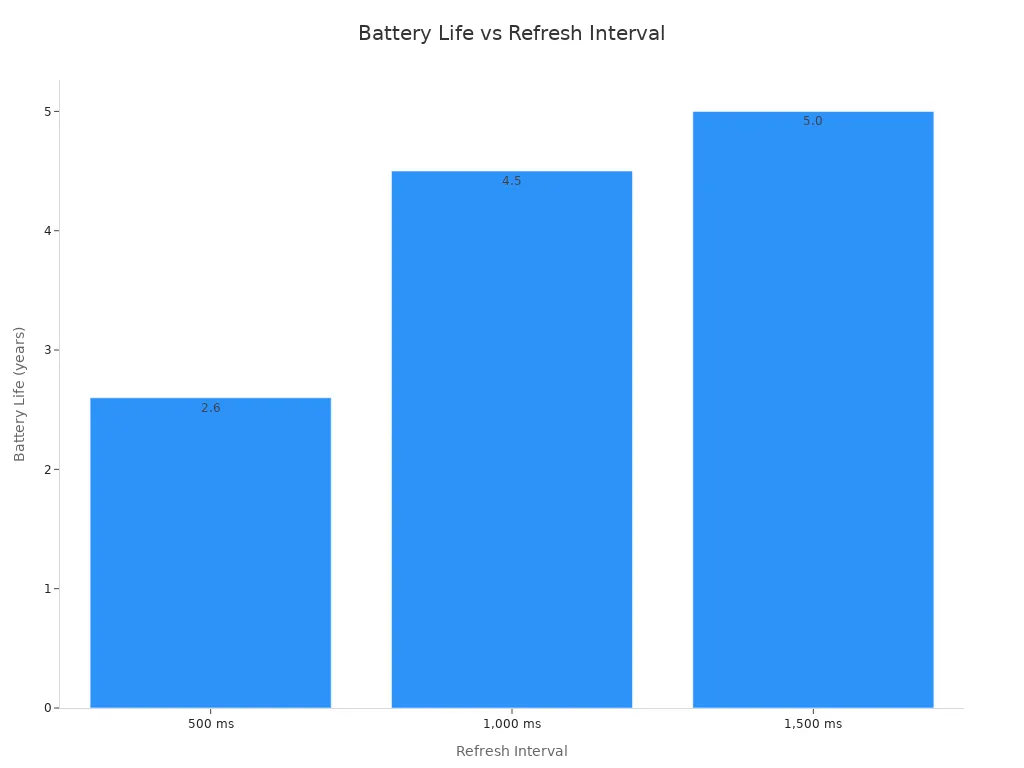
Faster updates give sharper location data and cost battery life. Datanet IoT publishes estimates that assume the tag moves half the time:
Refresh interval | Estimated battery life |
|---|---|
2.6 years | |
1,000 ms | 4.5 years |
1,500 ms | 5.0 years |
The gain is not linear. Datanet IoT notes that tripling the interval does not triple the life, because sleep-mode draw and wake-up events consume current at any rate. The chart from Datanet IoT shows the same pattern.
A mustering zone can accept a slower rate. A doorway lane may need a faster one. The buyer should set a rate per zone, not one rate for the whole site.
Confirm System Compatibility
Reader and gateway cross-brand compatibility
Tags, readers, and gateways must speak the same protocol. A mixed fleet raises cost and support risk. The buyer should ask each maker whether its readers accept third-party tags and whether its tags work on other gateways. A clear answer now prevents a locked-in estate later.
Access control and time-and-attendance integration
Personnel tags often double as access badges. AssetPulse reports that its time-and-attendance system uses the same badges employees already carry for access control. Fixed readers at entry points capture arrival and departure data without badge swiping. RFID Card notes that readers at the access entrance record arrival and departure times automatically. Both sources describe data flowing into payroll, HR, and access systems through an API. The buyer should confirm the integration path before purchase.
Plan for Scalability
Tag capacity per reader and site
Every reader has a limit on tags it can handle in a given window. Dense zones with many workers raise the risk of missed reads. The buyer should ask for the tested tag count per reader and per zone. A pilot at full shift density reveals the real ceiling.
Adding zones and shifts without redesign
Growth should not force a rebuild. DreamzCMMS describes zone configuration with entry and exit alerts, movement history, and multi-site views. Its Shift Master module groups staff by shift and team, with defined start and end times and break settings. DreamzCMMS also advises starting with one team and one site, then expanding after the pilot validates badge identity, timestamps, and record reconciliation. That sequence protects the budget and proves the design.
Verify Regulatory Compliance
Confirm RF and Safety Certifications
Regional RF approvals for operating locations
Radio equipment must be approved in every country where it is used. A tag approved for one market may not have the mark another country requires. The buyer should list every site country and ask each manufacturer for the matching certificates. Common marks include FCC approval for the United States and CE marking for the European Union. A supplier that sells globally keeps these documents ready. A supplier that serves one region may need extra time to certify a new market. The buyer should confirm the certificate covers the exact model and frequency band in use. A certificate for a similar model does not protect the plant during an inspection.
RF exposure limits for wearable tags
Wearable tags stay close to the body for a full shift. Regulators set exposure limits for radio transmitters near people. The buyer should ask for the exposure assessment behind each tag model. The assessment should cover the tag's transmit power and its typical mounting position. A badge clipped to a chest pocket and a wristband worn on the arm expose the body differently. The manufacturer should state which mounting positions the assessment covers. Buyers should also confirm the tag lowers its power when it touches skin. A clear answer here protects workers and supports the site's safety case.
Check Industry and Site Standards
Intrinsically safe options for hazardous areas
Some factory zones contain flammable dust or gas. Standard electronics can spark and set off these atmospheres. The buyer should find every hazardous zone on site and ask whether the manufacturer offers an intrinsically safe tag. Certification schemes such as ATEX in Europe and IECEx internationally define these ratings. A certified tag costs more and often has a shorter battery life. The buyer should save it for the zones that truly need it. Standard tags can serve the rest of the plant at lower cost.
Alignment with factory safety policies
A tracking system should make the site's safety rules stronger, not sit beside them. Peak PTT describes how leading systems support this goal. AB&R provides live headcounts by zone, automated entry and exit logs, and mustering support using last-seen locations. GAO RFID adds zone and restriction alerts that tell supervisors right away. Sewio feeds location events into safety, workforce management, and MES systems through APIs. Each system suits factories, warehouses, and construction sites where safety and mustering speed matter. The buyer should match these functions to the plant's own evacuation plan and restricted-area rules before choosing a vendor.
Compare Cost Structures
Price tags rarely tell the full story. A cheap tag with a short battery life can cost more over five years than a premium tag that runs for a decade. Buyers should build a full cost picture before they compare vendors.
Look Beyond Unit Price
Total cost of ownership components
A total cost of ownership model covers more than the tag itself. It includes readers, gateways, mounting hardware, cabling, installation labor, software licenses, and training. Implementation cost deserves its own line. Site surveys, commissioning, and integration work often rival the hardware spend on a first deployment. Buyers should also map the return on investment. Fewer manual headcounts, faster mustering, and tighter time-and-attendance records all produce measurable savings. The system must tie into the warehouse management system and the ERP before anyone signs with a manufacturer. Clean data flow into those platforms turns tag reads into payroll entries, inventory movements, and safety reports. A vendor who cannot explain that connection leaves the buyer with a costly island of data.
Battery replacement and tag lifecycle costs
Active tags carry a battery, and that battery sets the maintenance schedule. Itemit reports that active tags usually cost between $10 and $100 or more per tag, with a lifespan limited by battery life of up to 5–10 years. Link-labs notes that some systems use disposable tags while others allow battery replacement. Either way, the battery life cycle cost and the associated labor belong in the budget.
Feature | Passive RFID Tags | Active RFID Tags |
|---|---|---|
Cost | — | Usually $10 to $100 or more per tag |
Lifespan | Virtually unlimited (no battery) | Limited by battery life (up to 5–10 years) |
Maintenance | Minimal, no battery replacement | Requires periodic battery replacement |
Evaluate Pricing Models
Volume pricing and multi-year agreements
Vendors rarely publish a discount curve. Datanet IoT reports that RFID, Inc. invites bulk quotations, and the industry norm is meaningful price breaks starting around 1,000 units. Multi-year agreements can lock in pricing and support terms. Buyers should request the full five-year ownership cost before comparing vendors on tag price alone.
Subscription vs. one-time purchase
Recurring fees change the math. Datanet IoT notes that most active RFID systems carry monthly or annual fees for software licenses, cloud hosting, and support contracts. Some UWB RTLS vendors charge over $2,000 annually for production licenses starting in year two, and starter kits list in the $6,000 to $8,000 range. Over five years, that recurring cost can exceed the original hardware purchase. Competitive pricing still matters, but buyers should weigh it against performance and support rather than treat it as the only deciding factor.
Verify Vendor Support
Good hardware still needs good backup. How a manufacturer supports its products decides how fast a plant gets back on track after a tag fails or a reader is set up wrong. Buyers should test this area as carefully as they test specs.
Assess Technical Support
Pre-sales engineering and site surveys
A strong manufacturer puts in engineering time before the sale. Its team looks at the floor plan, the metal structures, and how people and equipment move. Then it suggests reader placement and tag types that fit the site. This pre-sales work shows the difference between a real partner and a company that just sells from a catalog. MarktraceRFID offers pre-sale consulting as part of its standard service, and its engineers design reader motherboards and antenna modules in-house. That depth lets the vendor shape a layout for a specific plant instead of forcing a stock setup.
A site survey turns guesses into facts. The survey team walks the target zones and measures how signals act near machinery and steel racks. It notes where reads drop and where reflections confuse the reader. The buyer should ask whether the survey is free or paid, and whether the report includes suggested reader counts. A vendor that skips this step leaves the plant to find problems after installation.
SLAs and replacement policies
A service level agreement sets the rules for response and repair. The buyer should check the stated response time for urgent faults and the process for shipping a replacement tag. Clear terms protect uptime during a busy production run. A low field failure rate backs those terms with proof. MarktraceRFID reports a product repair rate of 0.4 percent, which gives buyers a real reliability signal to weigh alongside the contract language.
Replacement policy deserves a close read. Some vendors swap failed units at no charge during a warranty window. Others repair them and bill for labor. The buyer should confirm which parts the warranty covers and how long the coverage lasts. A written policy beats a verbal promise, and the buyer should keep that document with the purchase records.
Confirm Integration Help
API and software integration assistance
Personnel tags only pay off when their data reaches the systems that use it. The manufacturer should supply documented APIs and software development kits. These tools let the plant's IT team pull tag events into access control, time-and-attendance, and safety platforms. MarktraceRFID provides SDKs and APIs with its products, and its team supports customers through the integration phase. The buyer should ask for sample code and a sandbox environment before signing.
Integration support also covers protocol questions. The buyer should confirm which data formats the vendor supports and whether its team will join calls with the plant's software vendor. A manufacturer that answers these questions with named engineers, not a generic inbox, tends to fix issues faster.
Installation, commissioning, and training
Installation quality shapes long-term performance. The vendor should define who mounts readers, who runs cabling, and who configures the software. Commissioning then checks that each zone reads at the expected rate under real traffic. The buyer should require a written commissioning report with measured results per zone.
Training closes the loop. Supervisors need to read dashboards, run muster reports, and handle a failed tag. Maintenance staff need a simple replacement procedure. The buyer should confirm the training format, the number of sessions, and whether refresher training is available. A vendor that trains the plant's own team cuts down on outside help.
Shortlist and Pilot

Build a Scored Shortlist
Weighted criteria from Step 1
The buyer now turns the earlier requirements into a scoring model. Each criterion from the first step gets a weight that reflects its importance to the plant. Read range in metal-dense zones may carry more weight than unit price. Compliance with local RF rules is a pass-or-fail gate, not a scored line. The buyer scores each candidate on the same scale and multiplies by the weight. The total shows which manufacturers deserve a closer look.
A useful starting point is a published list of top active and passive RFID tag manufacturers. The buyer filters that list through the weighted criteria and drops any vendor that fails a mandatory gate. This method keeps the shortlist short and defensible. Two or three finalists are enough for the next stage.
Key questions for each manufacturer
Each shortlisted vendor should answer the same set of questions in writing. Ask for documented test data behind battery-life and read-range claims. Ask which factory sites the vendor has equipped and whether it can share references. Ask how its readers handle third-party tags and which protocols they support. Ask for the certificate numbers that cover the exact model and frequency band. Consistent answers make the comparison fair.
The buyer should also ask about support terms. What response time does the service agreement promise? Who joins the integration calls? Does the vendor train the plant's own team? Written answers carry more weight than a sales call.
Request Samples and Run a Pilot
Pilot scope: zones, tags, duration
A pilot should test the real conditions, not a clean lab. The buyer selects two or three target zones: a doorway lane, a muster area, and one metal-dense bay work well. The pilot uses enough active RFID personnel tags to match full shift density in those zones. A duration of several weeks captures shift changes and peak traffic. The buyer should document reader placement and tag mounting for every zone.
Samples come first. The buyer requests a small batch of tags and mounts them as workers would wear them. This step reveals comfort problems and clip failures before the full pilot begins.
Success metrics before committing
The buyer defines pass marks before the pilot starts. Read accuracy in each target zone is the first metric. Battery performance under real traffic is the second. Integration checkpoints with access control, time-and-attendance, and safety systems form the third. Each checkpoint gets a date and an owner. A vendor that meets all three earns the contract. A vendor that misses a checkpoint gets a chance to fix it, or the buyer moves on.
The buyer should record results in a shared log. Clear evidence at the end of the pilot turns a difficult decision into a simple one.
The seven-step framework boils down to a checklist a buyer can copy and use again:
Define what you need: zones, environment, and tag style.
Compare active RFID personnel tags using proven specs and durability.
Check tracking fit, compatibility, and ability to grow.
Confirm RF and safety compliance.
Compare the total cost of ownership, not just the unit price.
Check vendor support and integration help.
Make a shortlist, then run a pilot with pass marks set in advance.
Next, the buyer finalizes requirements, scores two or three manufacturers against weighted criteria, and schedules a pilot in real zones. A structured evaluation works better than comparing a single spec. Evidence from the pilot, not a brochure, should guide the final contract.
FAQ
How long does a typical active RFID personnel tag last?
Battery life depends on how often the tag sends a signal. A tag that refreshes every 500 ms lasts about 2.6 years. Slowing the interval to 1,500 ms stretches that to roughly 5.0 years. Some systems let you replace the battery, while others use sealed tags you throw away. Buyers should budget for the maintenance labor either way.
Can one tag handle both access control and mustering?
Yes. Many factories use the same badge for door access, time-and-attendance, and muster reporting. Fixed readers at entry points capture arrival and departure data automatically. The buyer should confirm the software pushes those events into payroll, HR, and safety platforms through a documented API.
What read range should a factory expect at a doorway?
Doorway lanes need a short, controlled range. UHF RFID badges at smart turnstiles read from about 3–6 feet away. That tight window stops reads from the next lane over. Muster areas need far more reach, with some systems detecting tags up to 100 m typical and 400 m line-of-sight.
Do active tags work near steel racks and heavy machinery?
They work, but the site layout matters. Metal reflects radio waves and dense concrete shortens range. Motors and power lines add interference. A pre-sales site survey maps these problem areas and sets reader placement. Buyers should treat the survey as a required step, not an optional extra.
Is a higher IP rating always the better choice?
Not always. IP67 handles wash-down and temporary immersion, but it adds bulk and cost. IP65 suits most general production floors. IP54 covers light assembly in covered areas. The buyer should match the rating to the real exposure in each zone rather than defaulting to the highest number.
What does an active RFID personnel tag cost?
Tags usually run from $10 to $100 or more each, depending on features and ruggedness. Volume breaks often start around 1,000 units. Buyers should also count readers, installation, software licenses, and training. Recurring license fees can exceed the original hardware spend over five years.
How long should a pilot run before signing a contract?
Several weeks captures shift changes and peak traffic. The pilot should cover two or three real zones, such as a doorway, a muster area, and a metal-dense bay. The buyer sets pass marks in advance: read accuracy per zone, battery performance under load, and integration checkpoints with existing systems.
Which certifications should a manufacturer provide?
The vendor should supply the RF approval for every country where the tags operate, such as FCC for the United States or CE for the European Union. Hazardous zones need intrinsically safe models rated under schemes like ATEX or IECEx. Certificates must cover the exact model and frequency band in use.
- Next>:Suggest a reliable RFID people tracking system company

 2026-11-02
 Blogs