
Looking for a certified 2.4G RFID Reader company for asset tracking systems
Picking the right partner for asset tracking can decide if your project works. The global asset tracking market is expected to hit USD 26.18 billion in 2025, says Precedence Research. This growth gives you many choices, but also many risks. You must check if certifications are real, how well it works in real life like read range and connectivity, if it fits your current systems, the company's track record, after-sales support, and total cost. Focus on these things to judge a certified 2.4G RFID Reader company. This section gives you a clear plan for your evaluation.
Key Takeaways
Look for FCC and CE marks. These prove the reader follows the law.
Test the reader's read range inside your own building. Real conditions are what count.
Use readers with anti-collision features. They read many tags at once without mistakes.
Pick readers that have RESTful APIs. These link up easily with your software.
Make sure the reader works with both active and passive tags. This gives you more flexibility.
Pick a company that offers good tech help and has few repair problems. This saves time.
Figure out the total cost of ownership. Include the costs for setup, training, and upkeep.
A good reader system can pay for itself in under a year.
What Does a certified 2.4G RFID Reader Company Offer?
Certification and Compliance Standards
A certified 2.4G RFID Reader company shows its products follow tough industry rules. You should look for FCC certification for the US and CE marking for Europe. These labels prove the device passed tests for radio safety and electromagnetic interference. The ISO 18000-4 standard is also important. It sets rules for how active RFID systems talk at 2.4 GHz. A company that follows this standard makes sure your readers work with other devices that meet the same rules.
Compliance is more than one certificate. A trustworthy vendor has documents ready for you to see. You can ask for test reports, letters of conformity, and renewal dates. These papers keep your project safe from legal issues and signal delays. If a supplier is slow to share these files, see that as a warning sign.
Proven Expertise and Client Portfolio
Experience tells apart a reliable partner from a risky choice. A company with deep experience in research and development knows real-world problems. MarktraceRFID, for example, has extensive experience in IoT smart devices. This long history builds deep knowledge of asset tracking across many industries.
A strong client list also tells you a lot. MarktraceRFID has over 160 national invention patents. That number shows serious investment in new ideas. The company also reports a very low repair rate. A low repair rate means fewer failures and less downtime for your work. You can check if a vendor has worked with Fortune 500 companies or government programs. Past success with tough clients means your project will likely get similar care.
Customization and End-to-End Solutions
Every asset tracking project has its own needs. A good vendor offers customization instead of making you use a fixed product. You might need long-range detection, very low power use, or special interfaces. A certified 2.4G RFID Reader company with its own hardware design can adjust devices to your exact needs.
End-to-end solutions save you time and lower integration headaches. Look for a partner that gives you readers, tags, software, and technical support all in one place. MarktraceRFID provides active and passive RFID tags, cloud platforms, and SDKs for developers. They also offer pre-sale consulting and remote setup help. This full system means you deal with one contact instead of many. Your team spends less effort coordinating vendors and more time improving your asset tracking system.
Evaluating certified 2.4G RFID Reader Performance
Read Range, Accuracy, and Connectivity
Read range is the first number most buyers check, and it changes a lot from model to model. A certified 2.4G RFID Reader should give you power settings you can adjust instead of one set distance. The table below shows how much range differs across real products.
Product Model | Adjustable Read Range | Notes |
|---|---|---|
JT-T2450A | Up to 200 m | Depends on reader and antenna software configuration |
JT-T2466 | 0–180 m | — |
JT-T2460 | Up to 50 m | When matched with corresponding reader |
JT-T2483 | Up to 50 m | Stable in good visual environment |
JT-T2470 | Up to 40 m | Stable in good visual environment |
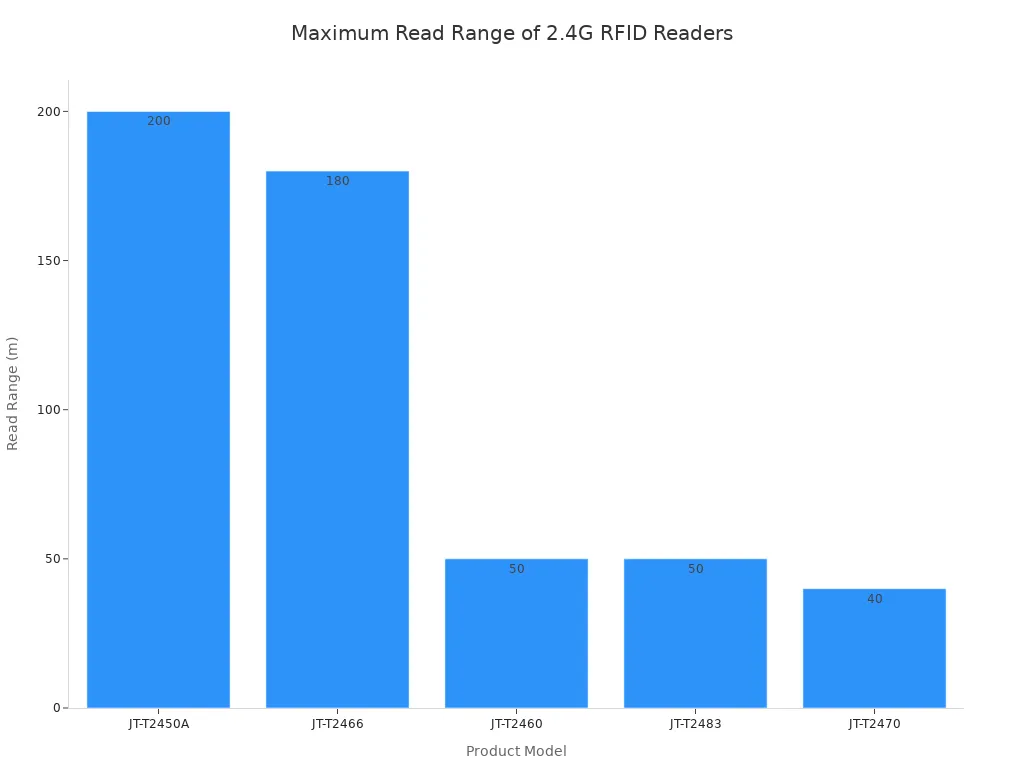
You should test range in your own building. Metal racks, walls, and moving vehicles all cut distance. A reader that claims 200 meters in open air may only reach a small part of that inside a warehouse. Ask the vendor for a pilot unit and measure the real coverage before you buy.
Connectivity matters just as much. Look for 4G, WiFi, and Bluetooth options so the reader can send data without extra gateways. Android OS support helps your team run apps they know and update firmware on site. These features lower your wiring costs and speed up use.
Durability and Environmental Adaptability
Industrial sites are hard on hardware. Dust, rain, vibration, and extreme heat all shorten device life. You should check the IP rating before you buy. Several 2.4G readers carry an IP65 rating, such as the SK1101A, SK1104A, and SK4105A models. That rating means the enclosure resists dust and water spray from any direction.
Temperature range is another key spec. The 2.45G Omni-Directional Active RFID Reader operates on the 2.4G ISM band from 2402 to 2483 MHz. It specifies an operating temperature range of -40°C to +85°C. That range covers freezing outdoor yards and hot factory floors alike. A reader that shuts down in summer heat will cost you data and trust.
Low power consumption keeps these devices running all day and night. Pair that with a rugged casing, and you get stable operation without constant battery swaps or maintenance visits.
Data Transfer and Anti-Collision Features
When many assets move through one zone, the reader must sort the signals. Anti-collision algorithms handle this job. The SK2107A tag uses an anti-collision algorithm with a recognition rate of up to 99 percent. The SK2108A tag reaches a recognition rate of 99 percent or higher. Both support reading multiple tags at the same time without data loss.
Reader-side performance follows the same pattern. The VI-2I01C and VI-2I04C readers use advanced anti-collision algorithms and a high-performance processor. Each can read over 200 tags at once. This capacity ensures complete and accurate identification within a very short time. For you, that means fewer missed reads at dock doors and faster cycle counts.
System Compatibility and Integration
API, SDK, and Software Integration
Your asset tracking system needs to link well with your current software. A certified 2.4G RFID Reader should work directly with ERP, WMS, and facility management systems. That way you don't have to build special connectors. The reader talks to the platforms your team already uses every day.
When checking vendors, look for RESTful APIs. These APIs connect easily with big company platforms. Your developers can get tag data into dashboards, set off alerts, and update inventory records without a lot of coding. A good vendor also gives you SDKs and technical manuals. Your IT team can use these tools to write small programs for special tasks. You get more flexibility without waiting for the vendor to add new features.
Tag Compatibility (Active vs. Passive)
Asset tracking projects often use both active and passive tags. Active tags have their own battery and send signals over long distances. Passive tags get power from the reader and work best at short range. Your reader must handle both types if your project covers different areas. A loading dock might use passive tags for quick scans. A yard full of trailers might need active tags for long-range detection.
Check the reader's supported frequency bands and protocols before you buy. Some readers only work with one tag type. Others switch between modes on their own. MarktraceRFID offers active, passive, and NFC tags from one source. This range lets you use one vendor and avoid compatibility problems. Ask the vendor for a tag compatibility list. Test your own tags with a pilot unit to make sure reads work in your setting.
Network and Protocol Support
Your readers must talk to your network without constant checking. Look for 4G, WiFi, and Bluetooth options in the reader specs. These choices let you set up in warehouses with strong WiFi or in remote yards with only cellular data. Android OS support helps your team run apps they know and update firmware on site. You lower wiring costs and speed up installation.
Protocol support matters for data flow. The reader should send data using standard formats your servers can read. ISO 18000-4 sets the rules for active RFID communication at 2.4 GHz. A reader that follows this standard works with other devices that meet it. You avoid getting locked into one vendor and protect your investment. Ask the vendor for a protocol document. Make sure the reader supports the message formats your backend expects.
Customer Support and Warranty
Technical Support and Training
Good support begins before you sign a contract. A certified 2.4G RFID Reader vendor should answer your tech questions while you are still deciding. Ask how fast they reply and how they deal with urgent problems. You want a partner who gives you a real engineer, not a call center that reads from a script.
Training is just as important. Your team needs to set up, adjust, and fix the readers without waiting days for help from outside. Look for vendors who give on-site training or live remote sessions. MarktraceRFID offers pre-sale consulting and remote setup help. That kind of hands-on support shortens your learning time and cuts down on costly mistakes during deployment.
Warranty Terms and Repair Rates
Warranty length is different across the industry, so read the small print. Goldbridge gives a 2-year warranty on its ACM302 and ACM-A95 readers, but those models use 433MHz instead of 2.4GHz. Unitech backs its MS822B 2.4G RFID reader with a 36-month hardware warranty. The same company also mentions a standard 15-month warranty with differences by region. You should check which term applies to your region and your exact model.
A long warranty means little if the hardware breaks often. Ask the vendor for their repair rate. MarktraceRFID reports a very low repair rate across its product lines. That number tells you how often units come back for fixes. A low repair rate saves you shipping costs, downtime, and frustration. Pair that number with clear warranty terms, and you get a realistic picture of long-term ownership costs.
Documentation and Remote Assistance
Clear documents speed up every part of your project. Ask for technical manuals, API references, and SDK guides before you buy. Your developers need these files to connect the reader with your ERP or warehouse system. Missing or unclear documents make your team guess, and guessing leads to errors.
Remote help fills the gap when something goes wrong. A good vendor can log in, check settings, and fix setup problems without sending a technician to your site. MarktraceRFID offers remote setup help as part of its support package. This service saves travel time and gets your readers back online faster. You should test the remote support process during your pilot phase. A quick test run shows whether the vendor responds fast and solves problems on the first try.
Pricing and Return on Investment
Total Cost of Ownership Analysis
The price tag on a reader is just the start. You also need to plan for setup, training, and upkeep. These hidden costs can make your total spending twice as much. Getting your network ready adds a lot of cost beyond the listed price. Training your staff is another big expense. All-in-one systems cut training time because the parts work well together. The table below shows the main cost types you should put in your budget.
Hidden Cost Category | Key Considerations for TCO |
|---|---|
Installation | Network setup adds significant cost. Integrated systems reduce complexity. |
Training | Staff training is a major hidden cost. All-in-one systems cut training time. |
Maintenance | Ongoing maintenance requires diagnostic tools and software. |
Technical Support | Check vendor response time, on-site support, and spare parts readiness. |
Integration | One-stop solutions lower complexity. Avoid paying multiple vendors. |
Upgrades & Batteries | Plan for future upgrades and battery replacement in active tags. |
Pricing Model | Subscription may lower initial costs but raise long-term expenses. |
Picking an integrated system means you deal with fewer vendors. This cuts both setup and training work. MarktraceRFID gives you readers, tags, and software from one place. That lowers integration hassle and makes upkeep simpler. You spend less time getting different parts to work together. This brings down both starting and ongoing costs.
ROI Timelines and Payback Period
Big asset tracking projects can pay you back very fast. Here is an example for a mid-sized city.
For a mid-sized city covering 500 square kilometers with 2 million vehicles, an initial investment of about $5.5 million is typical. The yearly benefit from less congestion and better asset tracking reaches $20 million. The 5-year return on investment ranges from 127% to 373%. The payback period is under one year.
Your own numbers will change based on size and gains in efficiency. But the main point stays true: a well-picked certified 2.4G RFID Reader makes your payback come faster. Fewer repairs mean less downtime. Lower upkeep costs boost your total return. You should ask each vendor for a projected ROI based on your own deployment. Warranty terms usually run from one to three years. A longer warranty lowers your risk and raises ROI.
Scalability and Future-Proofing
Your asset tracking needs will grow as time goes on. You should pick a system that grows without swapping out hardware. Look for readers that take software updates and work with new tag types. This keeps your investment safe and avoids pricey redesigns later.
Future-proofing also means planning for battery swaps. Active tags need new batteries every few years. Work this into your long-term budget. Pick a vendor that gives you a clear upgrade path. A vendor with a proven track record lowers the risk of outdated hardware. Follow standards like ISO 18000-4 to make sure your readers work with future tag designs.
You now have a clear plan for picking a partner. Check each vendor's certifications. Test read range and durability in your own building. Make sure the system works with your current software. Choose a company with strong support and a fast return on investment.
Ask your shortlisted vendors for detailed proposals. Run a pilot test with real assets. A certified 2.4G RFID Reader from a proven supplier lowers long-term risks. This careful selection process stops costly downtime and keeps your asset tracking project on track.
FAQ
What certifications should I check before buying a 2.4G RFID reader?
Look for FCC and CE marks on the device label. These show the reader passed radio safety and interference tests. Also ask for ISO 18000-4 compliance documents. This standard makes sure your reader talks properly with other 2.4 GHz devices. Ask for test reports and conformity letters before you buy.
How far can a 2.4G RFID reader detect my assets?
Read range changes by model and power settings. Some readers reach up to 200 meters in open air. Others work best within 40 to 50 meters. Walls, metal racks, and vehicles cut distance a lot. Always test range inside your own facility before you buy.
Can I use both active and passive tags with one reader?
It depends on the reader's design. Some models support only one tag type. Others switch between active, passive, and NFC modes on their own. MarktraceRFID offers all three tag types from one source. Ask your vendor for a compatibility list and test your own tags during a pilot.
What environmental conditions can these readers handle?
Look for an IP65 rating for dust and water resistance. Some readers work from -40°C to +85°C. That range covers freezing yards and hot factory floors. Low power use keeps devices running all day and night. Strong casings mean fewer maintenance visits and battery swaps.
How do anti-collision features help my asset tracking?
Anti-collision algorithms let one reader capture many tags at once. Some readers identify over 200 tags at the same time. Tag recognition rates can reach 99 percent or higher. This means fewer missed reads at dock doors. Your cycle counts finish faster with complete data.
What support should a vendor provide after purchase?
A good vendor offers technical manuals, API references, and SDK guides. Your developers need these files to link readers with your ERP or warehouse system. Remote setup help saves travel time when problems come up. MarktraceRFID gives pre-sale consulting and remote configuration help. Test the support process during your pilot phase.
How long does a typical warranty last?
Warranty terms differ across the industry. Some vendors offer 15-month coverage. Others give 36 months depending on region and model. Always check which term fits your exact product. A low repair rate matters more than a long warranty. MarktraceRFID reports a very low repair rate across its product lines.
What is the typical payback period for an asset tracking project?
A mid-sized city project with 2 million vehicles can pay back in under one year. The five-year return on investment ranges from 127 to 373 percent. Your own numbers depend on project size and efficiency gains. Ask each vendor for a projected ROI based on your deployment. Fewer repairs and lower upkeep boost your total return.

 2026-06-23
 Blogs
Blogs